

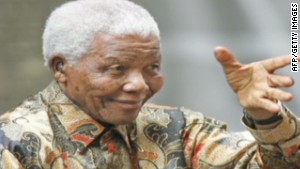
 -- Former South African leader Nelson Mandela remained in intensive care Monday, two days after he was hospitalized with a recurring lung infection.
The increasingly frail
Mandela was rushed to a hospital in Pretoria on Saturday. Later in the
day, the South African president's office said the 94-year-old former
leader was in a "serious but stable condition."
He was breathing on his own and his wife was by his side, the office said at the time.
After offering no updates for 48 hours, the government said Monday that Mandela's condition was "unchanged."
Meanwhile, his daughter
Zenani Dlamini, who is the South African ambassador to Argentina, has
flown back to South Africa to be with her father.
'We will release him'
On Sunday, South Africans offered prayers at church services, and well-wishes poured in for Mandela from across the world.
Meanwhile, the front page of South Africa's Sunday Times read, "It's time to let him go."
The paper quoted
Mandela's longtime friend Andrew Mlangeni as saying that the time may
have come for South Africans to say goodbye to the beloved icon.
"You have been coming to
the hospital too many times. Quite clearly you are not well and there
is a possibility you might not be well again," Mlangeni told the paper.
"Once the family
releases him, the people of South Africa will follow. We will say thank
you, God, you have given us this man, and we will release him too,"
Mlangeni said.
History of ailments
South Africa's first
black president gets round-the-clock care, and his house is fitted with
medical equipment that mirrors that of an intensive care unit.
His history of lung
problems dates to when he was a political prisoner on Robben Island
during apartheid, and he has battled respiratory infections over the
years.
Last year, he spent
Christmas holidays undergoing treatment for a lung infection and
gallstones, one of his longest hospital stays since his release from
prison in 1990.
Considered the founding
father of South Africa's democracy, Mandela became an international
figure while enduring 27 years in prison for fighting against apartheid,
the country's system of racial segregation.
"He has taught us ...
that we enhance our own humanity when we serve and make a difference to
other people's lives," presidential spokesman Mac Maharaj said. "It's
easy to serve oneself, own interests, but serving the interests of
others, making their lives better changes the quality of all humanity."
In 1993, Mandela and then-South African President F.W. de Klerk jointly won the Nobel Peace Prize.
Hero of democracy
The iconic leader was elected the nation's first black president a year later, serving only one term, as he had promised.
He has not appeared in public since South Africa hosted the World Cup in 2010.
But despite rare public
appearances in recent years, he retains his popularity and is considered
a hero of democracy in the nation. Last year, South Africa launched a
new batch of banknotes with a picture of a smiling Mandela on the front,
a testament to his iconic status.
Mandela's impact extends
far beyond South African borders. After he left office, he mediated
conflicts from Africa to the Middle East.


